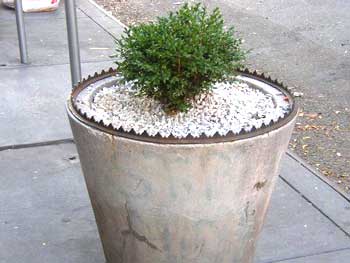
Transfer has an amazing collection of images of ‘Anti-Sit’ devices, mostly in New York but also internationally.
Taking a look through the photos, it’s clear that only in a very few cases (the air-conditioning units and standpipes, for example) are there real ‘functional’ reasons for preventing people sitting down on them, i.e. to prevent possible damage. In most of the examples, the spikes or jagged edges appear to have been put there purely as social engineering: these are public spaces and yet the public is being subjected to an architecture of control which says “You can’t sit (or lie) down here and rest. Move on.” Indeed, it’s almost as if someone despises the public, or at least those members of it who want – or need – to sit down.
Nail-type spikes are common in many towns here in the UK to prevent pigeons or other birds perching on particular ledges or window sills, particularly on higher level features that would be difficult to clean, but I don’t think we (yet) commonly have the degree of anti-sit architectures of control shown in the Transfer examples – though I might be wrong!
As some of the comments note, the possibility of someone tripping or falling onto some of these spikes, and being seriously injury (and litigious) is surely something to consider? Car bonnet mascots have been outlawed due to the possibility of injury to pedestrians, and yet councils and building owners are allowed to fit far more dangerous devices such as these spikes, which are specifically designed to injure pedestrians who aren’t warned off by their appearance.
Thanks to Deborah for letting me know!
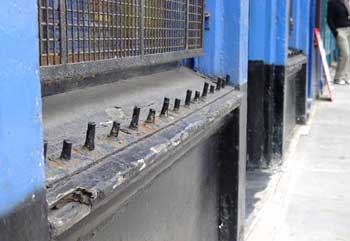
Images from Transfer: The Anti-Sit Archives


Hi,
indeed, I think that those devices are needed sometimes. I live(and blog about IT; UI design and Palm OS) in austria and have already been slowed down multiple times by gangs of tenagers rotting up in subway stations….such devices would be a godsend for viena IMHO..
Feel free to drop me an email so that we can discuss the matter further!
Best regards
Tam Hanna
I know what you mean, but wouldn’t it make for a more enlightened society if we looked at why certain urban architecture helps to foment ‘no-go areas’ or areas where people feel uncomfortable in the first place?
Gangs of people, teenagers or otherwise, will always appear more intimidating when you meet them in the darkness and claustrophobia of a subway station than sitting on the edge of a planter or leaning against a windowsill in bright sunlight.
[...] Nothing special, just another ‘pig ear’ I saw the other day, fixed to a concrete wall to prevent skateboarders using the edge. A more interesting example and, in a similar vein, the Anti-Sit Archives. [...]
[...] More anti-sit devices and anti-homeless benches. Please share this!These icons link to social bookmarking sites where readers can share and discover new web pages. [...]
[...] This is perhaps obvious, but is a good way to think about systems which are designed to prevent users carrying out certain tasks which might otherwise be easy – from copying music or video files, to sleeping on a park bench. Just as friction (brakes) can stop or slow down a car which would naturally roll down a hill under the force of gravity, so friction (DRM, or other architectures of control) attempts to stop or slow down the tendency for information to be copied, or for people to do what they do naturally. Sometimes the intention is actually to stop the proscribed behaviour (e.g. an anti-sit device); other times the intention is to force users to slow down or think about what they’re doing. [...]
[...] [Source: Architecture of Control] [...]
Rather than spending money on things that mean people carn’t sit down, why don’t u just spend that money on benches?
That’s a weird way of putting control on places where people shouldn’t sit on. Not only that, it’s pretty dangerous too. A kid may accidentally wound himself from those things.