 We’ve covered teaching machines and programmed learning textbooks a few times on the blog, and I’ll admit to a general fascination with analogue computing and similar ideas, ever since reading John Crank‘s Mathematics and Industry as a teenager, after finding it in a skip (dumpster) along with a lot of other very interesting books*. It was the idea that you could build an analogue electrical circuit, with resistors, capacitors and inductors, to model many physical phenomena (gravitational fields, etc), which really intrigued me, brought up in a world where computation was presented as entirely digital.
But I digress. A lot of the fascination comes from seeing a different way to explain a concept to someone else: a structured, alternative form of learning or understanding a problem, which is, somehow, immensely satisfying. There’s always the glint of a possibility that if we could find different ways to explain difficult or complex subjects, more people might be able to understand and appreciate them.
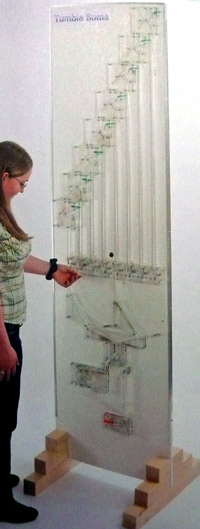
Sarah Burwood, a graduating Industrial Design student showing her work at Made in Brunel this week, has created Tumble Sums, a ‘Child’s Mechanical Visual Calculator’:
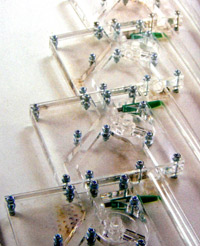
Helping children understand fundamental mathematical principles, Tumble Sums is a calculating tool which visually shows a child how an answer is being reached. Calculations are solved in a physical way, based solely on mechanical operations. Tumble Sums focuses on an understanding of the way children think, their mathematical understanding and the psychology behind these aspects.
It looks to be beautifully machined from acrylic sections, and that height alone makes it extremely imposing. Imagine one of these at the back of every primary-school classroom!
This concept of making hidden processes visible in order to aid the construction of the user’s mental models is something that will, I think, be an important component of lots of more advanced interfaces in the years ahead, particularly in areas where, fundamentally, we’re bad at understanding the consequences of our actions (environment, health, finances). It’s maybe allied to constructionism, though by no means the same idea.
*Incidentally, the morning I first turned up at Brunel again as a PhD student, I sat in the wonderful garden John Crank had created, reading Vance Packard’s The Waste Makers, waiting for the doors to the building to be unlocked.
Pingback: Dumpster Diving « Shawn Shahani
Pingback: Monkey Plunger » Blog Archive » Thoughtful Acts
Pingback: Code as control | Architectures | Dan Lockton