â– How to influence user behaviour
â– 12 inspirational design patterns in poster form (plus 35 more)
â– Grouped into 6 ‘lenses’ giving different perspectives
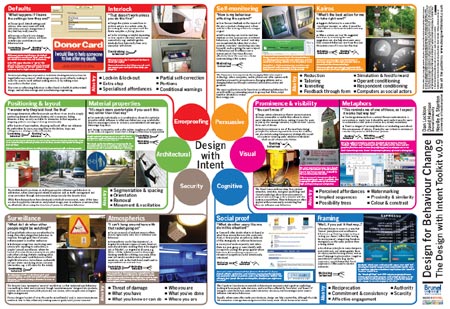
Download the poster (it’s a 1.3 MB PDF) – now also includes A4 pages for each lens, for easier printing [Alternative link]
 ***Please note***
This is an old version of the toolkit – the newer Design with Intent toolkit v.1.0 is also available and is much better!
Start with the problem
You have a product, service or environment–a system–where users’ behaviour is important to it working properly (safely, efficiently), so ideally you’d like people to use it in a certain way.
Or maybe you have a system where it would be desirable to alter the way that people use it, to improve things for users, the people around them, or society as a whole.
How can you modify the design, or redesign the system, to achieve this: to influence, or change users’ behaviour?
The design patterns
The Design with Intent Toolkit aims to help designers faced with ‘design for behaviour change’ briefs. The poster* features 12 design patterns which recur across design ï¬elds (interaction, products, architecture), and there are also 35 more detailed here on the website. Some of the names will be unfamiliar, but we hope the patterns and examples will be understandable, and inspire your own concepts.
Think about how you might apply the ideas to your brief, and what could work given what you know about the problem. If you get stuck, try combining ideas from different patterns: many real examples can be thought of as using two or more patterns.
The patterns are grouped into six ‘lenses’, each offering a different worldview on design and behaviour. The lenses allow you to ask “How might someone else approach the problem?” and ought to help you think outside your initial perspective (or your client’s):
Architectural lens
- Positioning & layout
- Material properties
- Segmentation & spacing
- Orientation
- Removal
- Movement & oscillation
Errorproofing lens
- Defaults
- Interlock
- Lock-in & lock-out
- Extra step
- Specialised affordances
- Partial self-correction
- Portions
- Conditional warnings
Persuasive lens
- Self-monitoring
- Kairos
- Reduction
- Tailoring
- Tunnelling
- Feedback through form
- Simulation & feedforward
- Operant conditioning
- Respondent conditioning
- Computers as social actors
Visual lens
- Prominence & visibility
- Metaphors
- Perceived affordances
- Implied sequences
- Possibility trees
- Watermarking
- Proximity & similarity
- Colour & contrast
Cognitive lens
- Social proof
- Framing
- Reciprocation
- Commitment and consistency
- Affective engagement
- Authority
- Scarcity
Security lens
- Surveillance
- Atmospherics
- Threat of damage
- What you have
- What you know or can do
- Who you are
- What you’ve done
- Where you are
A different approach: using the patterns as questions
Nedra Kline Weinreich, author of Hands-on Social Marketing, has created a clever Design Approach for Behaviour Change worksheet based on the 12 patterns from the Design with Intent poster, by re-framing each of the patterns as a question. This is a great idea, turning the patterns into cues for you to think about relative to your problem. After working through the questions, you pretty much end up with a set of possible solutions.
What sort of behaviour are you trying to achieve?
See the next page…
*Lockton, D., Harrison, D.J., Stanton, N.A. Design for Behaviour Change: The Design with Intent Toolkit v.0.9, Uxbridge: Brunel University 2009 (ISBN 978-1-902316-6-1 print; 978-1-902316-63-5 eBook), http://www.designwithintent.co.uk
____________________
The Design with Intent Toolkit v0.9 by Dan Lockton, David Harrison and Neville A. Stanton
Introduction | Behaviour | Architectural lens | Errorproofing lens | Persuasive lens | Visual lens | Cognitive lens | Security lens
Pingback: anthillz » Blog Archive » links for 2009-04-06
Pingback: Сборник паттернов Intent Toolkit | Usability.by
Pingback: » OLDaily per Stephen Downes, 13 d’abril de 2009 TIC, E/A, FER / PER…:
Pingback: Just found a very interesting blog for the design people of this network « Ableism and Ability Ethics and Governance
Pingback: Design with Intent Toolkit | Neatorama
Pingback: The Design with Intent Toolkit | EGM Weblog
Pingback: Design effects behaviour… how? « SUPERfluity
Pingback: Projektowanie perswazyjne i prewencyjne - user experience design: projektowanie interakcji i użyteczność
Pingback: Design with Intent | frog design on Design with Intent
Pingback: A Digital Outrigger / Library Usability Links 7/8/09
Pingback: naHipermÃdia » Blog Archive » O papel da visualização no design de aplicativos
Pingback: Home truths and having your mates round « stuff//stuffing//stuffed.
Pingback: Design with Intent | September workshop sessions: invitation
Pingback: O papel da visualização no design de aplicativos :: Luciano Lobato
Pingback: Cognição aumentada: esclarecimentos :: Luciano Lobato
Pingback: Design for persuasion – aftermath « Mediachannel by Christel De Maeyer
Pingback: Design with Intent | Some interesting projects (Part 2)
Pingback: Mayo Nissen » CIID 09/10: Video Prototyping
Pingback: Wireframing and “Design with Intent” principles « IWM14
Pingback: Design with Intent | What’s happening with the toolkit (Part 1)
Pingback: Cognitive Design » Blog Archive » 47 Ways to Design for Behavior Change
Pingback: Putting people first » Design for sustainable behaviour (part 1)
Pingback: Diferenças entre UX, AI, IxD e DI :: Luciano Lobato
Pingback: Design with Intent | Learning from game design: 11 gambits for influencing user behaviour
Pingback: A Ludic Approach to Designing Behaviour
Pingback: Projektowanie perswazyjne – czego możemy nauczyć siÄ™ od twórców gier
Pingback: Designing with Lenses | UX Booth
Pingback: Design with Intent | Design with Intent toolkit 1.0 now online
Pingback: Web analytics and conversion essentials > Smart Insights Digital Marketing
Pingback: Four Design Links: July 22, 2010 -- BlogLESS: A Blog about Design Ethics
Pingback: Diferenças entre UX, AI, IxD e DI « Once more Violet Behaviour
Pingback: Social Marketer | Blog | The Tip Jar - 10/15/09
Pingback: Design with Intent « E Waste
Pingback: 为什么åŠå¯¼å¼è®¾è®¡å°†æ˜¯ä½ 的下一个必备技能
Pingback: Why Persuasive Design Should Be Your Next Skill Set «
Pingback: 为什么åŠå¯¼å¼è®¾è®¡å°†æ˜¯ä½ 的下一个必备技能 | 优酪网
Pingback: 什么是åŠå¯¼å¼è®¾è®¡ï¼Ÿ « 举旗网
Pingback: 为什么åŠå¯¼å¼è®¾è®¡å°†æ˜¯ä½ 的下一个必备技能 | 安å“眼.AndroidEye
Pingback: 为什么åŠå¯¼å¼è®¾è®¡å°†æ˜¯ä½ 的下一个必备技能 - 挨踢男-èšç„¦ç§»åŠ¨äº’è”网创新与创业,挖掘深度评论,分享阅读视角
Pingback: Persuasive Design | Nick Interaction Design — 交互设计
Pingback: Persuasive Design | Nick Interaction Design --- 交互设计
Pingback: The Tip Jar – 10/15/09
Pingback: 101 Patterns for Influencing Behaviour Through Design | halfblog.net
Pingback: Why Persuasive Design Should Be Your Next Skill Set - Designerama
Pingback: Persuasive design « Using interactive visualizations to create learning
Pingback: Design with Intent toolkit – resource to encourage different perspectives on design | The Attic