This diagram is a simplistic attempt to place some of the architectures of control detailed on this site into a plane representing the strategic intentions behind them: the dimensions are intended commercial benefit, and intended social benefit. Please click to open in a new window [PNG-8, 135k].
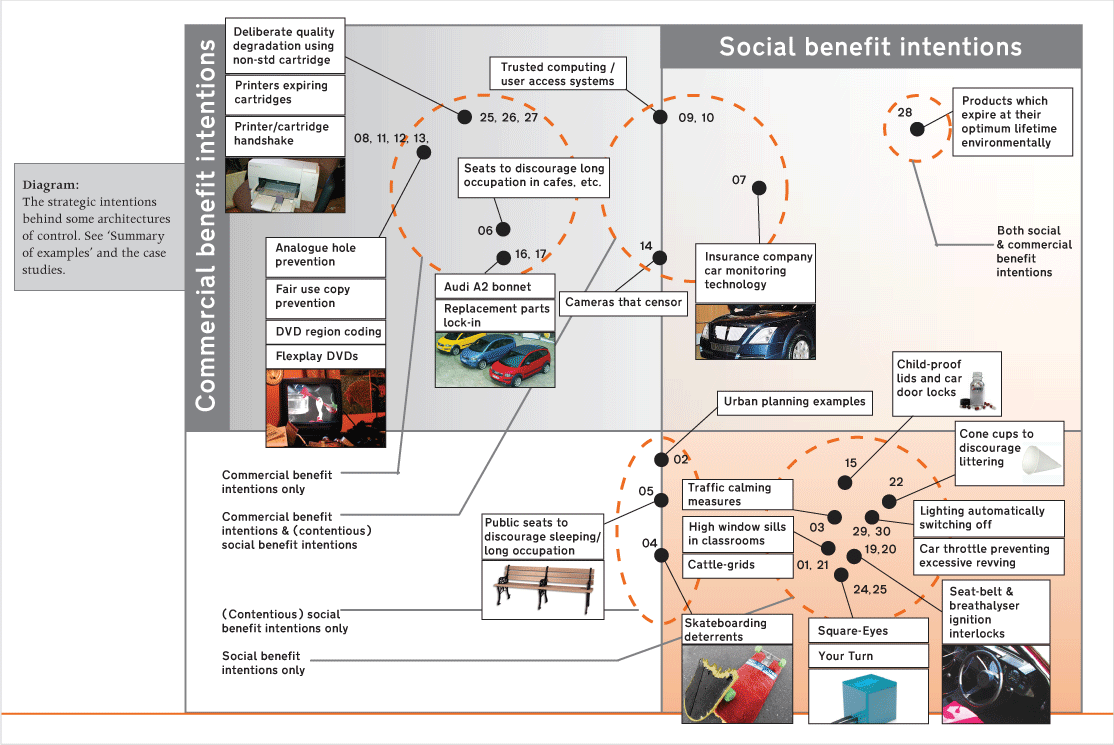
A diagrammatic representation of the intentions behind different architectures of control in design


Previous: Case study: printer cartridges | Next: Artefacts & politics


@danlockton

Upcoming talks & events

I'm speaking or running workshops at:

Some of my previous presentations

Comments & trackbacks

Blog 2005-date

Subscribe (RSS)

Written by Dan Lockton, 2004-13. Blog formerly known as Architectures of Control and Design with Intent.

Theme is Blogum by Wpshower

Fonts are Lil Grotesk and Linux Libertine

Powered by WordPress

4 comments
  1. [...] As an architecture of control, the phone signal blocking is (suprisingly rarely!) something which appears to have both commercial benefits and ’social’ benefits (see diagram, and discussion), although the social benefits are for the majority of the cinema audience rather than society as a whole. [...]

  2. [...] As we’ve seen with the architectures of control on this site, there are a handful of examples where commercial benefit and social benefit (often contentious: that’s the ‘politics’ aspect) intentions coincide to produce something which, by controlling or limiting the user’s actions, is designed to improve the user experience as well as the financial return, but it really is just a handful. [...]

  3. [...] The government proposals are – on the face of it – largely a rare case of a ‘win-win’ architecture of control (see diagram), though of course we need to consider the effects of the manufacture and distribution of so many millions more products (and probably, the disposal of the old ones). If we argue that this would have happened anyway (which is surely true) then the effect will be better than if the replacement devices had no environmental considerations going into their design, but this is the kind of situation where a full life-cycle analysis would be very useful. [...]

  4. [...] I can understand the safety reasoning – and this genuinely is an architecture of control with intended social benefit – but in many places where it’s applied, I believe it to be flawed. One of the main features of roundabouts as originally introduced was that they allowed non-discriminatory free flow to any traffic which was unopposed, i.e. if nothing’s coming from the right (UK) you can proceed without actually having to halt: all roads meeting at a roundabout have to give way to whoever’s already on the roundabout. It’s the ultimate in both deference and empowerment. [...]

Submit comment