Printer cartridges are a consumer product category with a variety of architectures of control exhibiting characteristics discussed on this site.
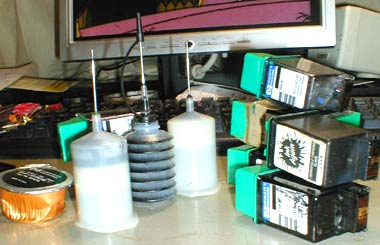
Refills for printer cartridges, both DIY and factory-refilled, can be rendered useless by some built-in architectures of control
Aside from the obvious economic lock-in (the razor blade model), there are some specific implementations that are worth detailing further (all are assumed to have commercial benefit and little social benefit; see the diagram for their positioning):
| No. | Example | Details | Notes on ‘work factor’ |
|---|---|---|---|
| 25 | Canon (Japan) printers detect whether or not genuine Canon replacement cartridges are used (the ‘handshake’), and refuse to print if a non-Canon cartridge (often cheaper) is detected. | The Japanese Fair Trade Commission is investigating. Canon has previously lost a case over whether external companies recycling (refilling) Canon brand cartridges infringes Canon’s intellectual property rights [98]. | Refilled cartridges retaining ‘genuine Canon cartridge’ chip possible; Self-refilling is also possible. |
| 26 | Some Hewlett-Packard printers report that printer cartridges need replacement and also shut down the cartridges at a pre-determined date regardless of whether they are empty–even if they have never been used. | The argument could be made that this is to protect the consumer from a cartridge that no longer functions properly due to ink becoming denatured or the print head blocked, but this is a rather weak benefit for the consumer. A Georgia woman is currently suing Hewlett-Packard over this issue, with the suit seeking class-action status [101] | Providing consumers know to avoid Hewlett-Packard printers with the expiration function, they can choose alternatives. |
| 27 | Some manufacturers which produce printers and cartridges under different brands with different pricing levels allegedly permit the cheaper brand’s cartridges to function, but make sure the print quality is poor to discourage consumers from further purchases. | “I have a Dell AIO 920… which is a rebadged Lexmark 1150. Local PC store does Lexmark cartridges for the 1150 that fit the Dell–almost. The cartridge is identical apart from the top cover–it’s a recessed ‘U’ shape on the Dell cartridge, but has a raised diagonal plastic tab on the Lexmark–upshot is, you load it in, close the lid, and all your printing is badly misaligned (colour against black). No way of adjusting it to fit with the supplied software as it is so far out of alignment” [102]. | “Solution? Snap off the diagonal tab–works a treat!” [102] However, if this had been a software issue rather than a simple physical one, there may not be such an easy work-around. |
| * | Lexmark laser printers perform a handshake with cartridges and will not operate with cartridges identified as non-Lexmark. Static Control Components replicated handshake to enable replacement cartridges to work with Lexmark printers [99]. | Lexmark sued SCC under the DMCA; the sale of the SCC handshake chips was banned but the ban was lifted on appeal. “The DMCA was not intended to create aftermarket electronic monopolies…[this] is amajor victory for the consuming public and American companies” (Ed Swartz, SCC chief executive) [100]. | Alternative laser printers available which do not have ahandshake function. |
*This is an example of a company producing a work-around for an architecture of control rather than an architecture of control itself, so has not been included on the numbered list or the diagram
Previous: Strategic intentions | Next: Strategic intentions: a diagrammatic representation
Pingback: Architectures of Control in Design » The fight back: Dongle sharing
Pingback: Architectures of Control in Design » The fight back: Refill ‘er up
Pingback: Architectures of Control in Design » The fight back: Defeating cartridge expiry
Pingback: Architectures of Control in Design » Forcing functions designed to increase product consumption
Pingback: Architectures of Control in Design » Friend or foe: Battery-authentication ICs?
Pingback: Architectures of Control in Design » Ed Felten: DRM Wars, and ‘Property Rights Management’
Pingback: Who holds your keys? - Programming - O'Reilly Media
Pingback: Who holds your keys? - O'Reilly Radar
Pingback: Who holds your keys? - O'Reilly Radar