Archive
Creeping erosion of norms

Concrete

Review: Katyal, N. K. “Architecture as Crime Control”, Yale Law Journal, March 2002, Vol 111, Issue 5.

Professor Neal Kumar Katyal of Georgetown University Law School, best-known for being (successful) lead counsel in the Hamdan v. Rumsfeld case dealing with Guantanamo Bay detainees, has also done some important work on the use of design as a method of law enforcement in both the digital and built environments.

This article, ‘Architecture as Crime Control’, specifically addresses itself to a legal and social policy-maker audience in terms of the areas of focus and the arguments used, but is also very relevant to architects and designers open to being enlightened about the strategic value of their work. Specifically with regard to ‘architectures of control’ and ‘design for behaviour change’, as one might expect, there are many useful examples and a great deal of interesting analysis. In this review, I will try to concentrate on examples and design techniques given in the article, along with some of the thinking behind them – the most useful aspects from the point of view of my own research – rather than attempting to analyse the legal and sociological framework into which all of this fits.

Katyal starts by acknowledging how the “emerging field of cyberlaw, associated most directly with Lawrence Lessig” has brought the idea of ‘code’ constraining behaviour to a level of greater awareness, but suggests that the greater permanence and endurance of architectural changes in the real world – the built environment – may actually give greater potential for behaviour control, as opposed to the “infinitely malleable” architecture of cyberspace:

It is time to reverse-engineer cyberlaw’s insights, and to assess methodically whether changes to the architecture of our streets and buildings can reduce criminal activity.

A theme to which Katyal returns throughout the article is that the policy response to James Wilson and George Kelling’s influential ‘Broken Windows’ – “an architectural problem in crime control” – has largely been a law enforcement one (“prosecution of minor offenses like vandalism in an attempt to deter these ‘gateway crimes’”) instead of actual architectural responses, which, Katyal argues, could have a significant and useful role in this field.

Design principles

Before tackling specific architectural strategies, Katyal discusses the general area of using “design principles” to “influence, in subtle ways, the paths by which we live and think” – a great summary of many of the techniques we’ve considered on this blog over the last couple of years, though not all have been subtle – and gives some good examples:

McDonald's seating, uncomfortable, Glasgow, from Headphonaught's Flickr stream

Fast food restaurants use hard chairs that quickly grow uncomfortable so that customers rapidly turn over

Image from Headphonaught’s Flickr stream

Elevator (lift) numerals positioned to avoid eye contact

Elevator designers place the numerals and floor indicator lights over people’s heads so that they avoid eye contact and feel less crowded

Supermarkets have narrow aisles so that customers cannot easily talk to each other and must focus on the products instead

(We’ve also seen the opposite effect cited, i.e. using wider aisles to cause customers to spend longer in a particular aisle – clearly, both effects could be employed in different product areas within the same supermarket, to suit whatever strategy the retailer has. There are plenty of other tricks too.)

And, in a footnote, Katyal cites Personal Space by Robert Sommer, which provides:

other examples, such as a café that hired an architect to design a chair that placed “disagreeable pressure on the spine if occupied for over a few minutes” and Conrad Hilton’s decision to move couches out of hotel lobbies to minimise the number of lingering visitors.

(Sommer’s work sounds interesting and relevant, and I look forward to investigating it*)

As Katyal puts it, “with strategies like these, private architects are currently engaging in social control.”

Moving on to architectural strategies for crime control, Katyal expounds four ‘mechanisms’ identified in the field of Crime Prevention Through Environmental Design (CPTED):

Design should:

  • (1) Create opportunities for natrual surveillance by residents, neighbors and bystanders;
  • (2) Instill a sense of territoriality so that residents develop proprietary attitudes and outsiders feel deterred from entering a private space;
  • (3) Build communities and avoid social isolation;
  • (4) Protect targets of crime.
  • Before expanding on the practical and legal application of each of these mechanisms, Katyal makes the point that while they can often “work in synergy… natural surveillance is most effective when social isolation is minimized and when design delays the perpetration of crime,” there can be conflicts and any strategy needs to be developed within the context of the community in which it is going to be applied:

    Security door propped open

    Effective design requires input by the community. Without such input, security features are likely to be resented, taken down or evaded (consider the ‘security’ doors propped open on campuses today.

    (This issue of ‘resentment’ or even ‘inconvenience’ is, I feel, going to be a significant factor in my own studies of environmentally beneficial behaviour-changing products; we shall see.)

    Natural surveillance

    The idea of natural surveillance is to create situations where areas are overlooked by neighbours, other residents and so on, with the effect being both a crime deterrent (if the criminal knows he is being watched, or might be watched, he may decide against the crime) and to improve the effectiveness of solving the crime afterwards (someone will have seen what happened). Katyal cites Jane Jacobs‘ argument that diversity of use can be an important way of bringing about natural surveillance – preferably with different activities occurring throughout the day, to ensure that there is always a population there to keep any eye on things. However, short of this kind of deliberate diversity planning, there are specific techniques that can be used on individual buildings and their surroundings to increase natrual surveillance; Katyal suggests the addition of windows facing onto public spaces, ensuring sight lines down corridors and alleyways, positioning windows so that neighbours can watch each other’s houses, bringing parking areas in front of stores rather than out of sight behind them, and making sure hallways and lobbies are clearly visible to passers-by. He gives the example of redesigning the layout of a school’s grounds to increase the opportunity for natural surveillance:

    School before improvement
    School after improvement
    Images from Katyal, N. K. “Architecture as Crime Control”, Yale Law Journal, March 2002, Vol 111, Issue 5.

    [In the first image] the informal areas are blocked form sight and far from school grounds. Because no central place for congregation exists, students are spread over the grounds, and there is insufficient density for monitoring. The four open entrances and exits facilitate access to the school and escape.

    [In the second image,] through the designation of formal gathering areas, other places become subtly off-limits to students. Indeed, those who are present in such areas are likely to attract suspicion…. the formal gathering areas are naturally surveilled by building users… [and] are long and thin, running alongside the school windows, and two hedges prevent students from going fuarther away. Moreover, the west entrance, which had the least potential for surveillance, has been closed…

    Lighting can also be a major method of increasing natural surveillance:

    First, it helps anyone viewing a situation to see it more clearly and thereby deters some crimes by increasing the powers of perception of those watching. Second, it encourages people to be in the area in the first place because the greater visibility creates a sense of security. The more eyes on the street, the more visibility constrains crime.

    (Incidentally, Katyal comments – having interviewed an architect – that the use of yellow street lighting “can increase the crime rate by making streets (and individuals on them) look menacing”, hence a tendency for some urban developers to move to white lighting instead.)

    Territoriality

    Territoriality – also much of the focus of defensible space (which I’ll discuss in a later post) – “both provides an incentive for residents to take care of and monitor an area and subtly deters offenders by warning them that they are about to enter a private space.” Some of Katyal’s examples are wonderfully simple:

  • “An entrance raised by a few inches” is “a successful symbolic barrier… people are aware of minor graduations of elevation and may refrain from entry if they sense a gradual incline”. (Elevation can also lead to reverence/respect, either directly – e.g. steps leading up to a courthouse – or indirectly, causing a visitor to bow his/her head on approach)
  • Monuments and markers can also demarcate the transition from public space into private space… A study of burglaries in Salt Lake City… revealed that houses with nameplates had lower rates of intrusion than those without them.

  • One rather simple way is to place two buildings in an ‘L’ formation with a fence that completes the triangle. Children can play in the open space, and adults can look out of their windows at their children.

  • Katyal also includes these diagrams from “a group of British architects”:

    In the first, a series of buildings lacks a common entrance, and pedestrians cut through the property. The addition of a simple overhead arch, however, creates a sense of private space:

    Addition of archway to discourage use as through-route

    Images originally from Stollard, P. Crime Prevention Through Housing Design and included in Katyal’s article.

  • Building community

    The third main mechanism, building community, is also heavily interlinked with the idea of defensible space. The aim here is to encourage a sense of community, by creating spaces which cause people to interact, or even reducing the number of dwellings in each individual set so that people are more likely to recognise and come to know their neighbours – something many architects have instinctively tried to do anyway over the past 20 years or so, though not always explicitly with crime reduction in mind:

    …even the placement of seats and benches can bring people together or divide them, creating what architects call, respectively, sociopetal and sociofugal spaces. Some architects self-consciously create sociofugal spaces by, for example, designing chairs in airports that make it difficult for people to talk to each other.

    Practically, ‘building community’ would necessarily appear to be slightly more nebulous than some of the other mechanisms, but even techniques such as encouraging people to spend more time in communal areas such as a laundry (and hence potentially interact more) can be important here.

    Strengthening targets

    There are a number of simple examples of target hardening or strengthening given:

  • Placing deadbolts lower on door frames

    (presumably to make kicking them open more difficult)

  • Having doors in vulnerable locations swing outward

  • Raising fire escapes to put them out of easy reach

  • Reducing the size of letter-box openings

  • If a robber can stand on top of a trash bin and reach a second-floor window, the bin should be placed far from the window

  • Prickly shrubs placed outside of windows can also deter crime

  • A duct that spews hot air can be placed near a ground-floor window to deter entry

  • Smells can also be strategically harnessed either to induce people to come outside or keep them away

  • The FBI building is built on stilts to minimize damage in the event of a bomb detonation at street level

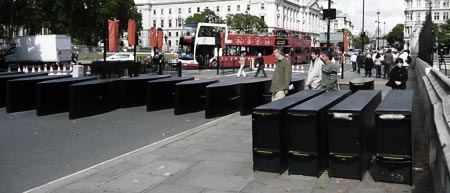
  • To decrease the likelihood of presidential assassination, a stretch of Pennsylvania Avenue in front of the White House was barricaded and closed to car traffic

  • Interestingly, Katyal makes the point that where potential crime targets can be strengthened without making it overly obvious that this has been done, the benefits may be greater:

    Modern technology permits targets to be hardened in ways that are not obvious to the public. Strong plastics, graffiti-resistant paint, and doors with steel cores are a few examples. These allow architects to disguise their efforts at strengthening targets and thus avoid sending a message that crime is rampant.

    Some forms of target hardening are suboptimal in that visibility evinces a fear of crime that can cause damage to the fabric of a community and even increase crime rates.

    He again later returns to this point:

    Subtle architecture that gently reinfoces law-abiding norms and prevents a degree of intrusion is to be preferred to explicit and awkward physical barricades that reflect the feeling that a community is under siege. Cheap wire fences do not express a belief in the power of law or norms; rather, they reflect the opposite. The same can be said for ugly iron bars on windows, which express the terror of crime as powerfully as does any sign or published crime statistic.

    A whole host of architectural strategies – such as the placement of doors and windows, creation of semipublic congregation spaces, street layout alterations, park redesign, and many more – sidestep creating an architecture dominated by the expression of fear. Indeed, cheap barricades often substitute for these subtler measures. Viewed this way, gated communities are a byproduct of public disregard of architecture, not a sustainable solution to crime.[my emphasis]

    (This last point is especially interesting to me – I must admit I am fascinated by the phenomenon of gated communities and what effect they have on their inhabitants as well as on the surrounding area, both in a Ballardian sense (Running Wild, Cocaine Nights, Super-Cannes) and, more prosaically, in terms of what this voluntary separation does to the community outside the gates. See also the quote from architect John Thompson in my forthcoming post reporting what’s happening at the former Brunel Runnymede Campus)

    Other aspects

    One point to which Katyal repeatedly returns is – a corollary of the above – the concept of architectural solutions as entities which subtly reinforce or embody norms (desirable ones, from the point of view of law enforcement) rather than necessarily enforce them in totality:

    Even the best social codes are quite useless if it is impossible to observe whether people comply with them. Architecture, by facilitating interaction and monitoring by members of a community, permits social norms to have greater impact. In this way, the power of architecture to influence social norms can even eclipse that of law, for law faces obvious difficulties when it attempts to regulate social interaction directly.

    Architecture can prevent crimes even when criminals believe the probability of enforcement is low… one feature of social norms strategies is that they are often self-enforcing.

    I think this is a crucial point, and is applicable in other ‘architectures of control’ techniques outside of the built environment and the specific issues of crime. Norms can be extremely powerful influencers of behaviour, and – to take my current research on changing user behaviour to reduce environmental impact – the ability to design a desirable norm into a product or system, without taking away the user’s sense of ownership of, and confidence in, the product, may well turn out to be the crux of the matter.

    As (I hope) will be clear, much of Katyal’s analysis seems applicable to other areas of ‘Design for/against X’ where human factors are involved – not just design against crime. So, for example, here Katyal is touching on something close to the concepts of perceived affordances (and disaffordances) in interaction design:

    Psychological evidence shows that criminals decode environmental ‘cues’ to assess the likelihood of success of a given criminal act… the design of a meeting table influences who will speak and when, and who is perceived to have a positionof authority. It is therefore no great shock that the eight months of negotiation that preceded the 1969 Paris Peace Talks largely centred on what the physical space of the negotiating table would be. It is said that Machiavelli designed a political meeting chamber with a ceiling that looked asif it were about to collapse, reasoning that it would induce politicians to vote quickly and leave.

    Winston Churchill… went so far as to claim that the shape of the House [of Commons] was essential to the two-party system and that its small size was critical for ‘free debate’:

    “The party system is much favoured by the oblong form of chamber… the act of crossing the floor is one which requires serious consideration. I am well informed on this matter, for I have accomplished that difficult process, not only once but twice.”

    Significant points are also made is about displacement (or “geographic substitution”) of crime: do architectual measures (especially target hardening and obvious surveillance, we might assume) not simply move crime elsewhere? (We’ve discussed this before when looking at blue lighting in public toilets.) Katyal argues that, while some displacement will, of course, occur, this is not always direct substitution. Locally-based criminals may not have knowledge of other areas (i.e. the certainty that these will not be hardened or surveilled targets), or indeed, where crime is opportunistic, the “costs” imposed by travelling elsewhere to commit it are too high. Equally:

    Many devices, such as steel-reinforced doors, strong plastics, and the like are not discernible until a criminal has invested some energy and time. These forms of precaution will thus increase expected perpetration cost and deter offenders without risking substantial displacement.

    Also, the fact that increased police presence (for example) in a crime ‘hot-spot’ may also lead to crime displacement, is generally not seen as a reason for not increasing that presence: some targets simply are more desirable to protect than others, and where architectural measures allow police to concentrate elsewhere, this may even be an advantage.

    More specific examples

    Aside from the analysis, there are a great many architectures of control and persuasion examples dotted throughout Katyal’s article, and while they are somewhat disparate in how I present them here, they are all worth noting from my point of view, and I hope interesting. Apart from those I’ve already quoted above, some of the other notable examples and observations are:

  • …the feeling of being crowded correlates with aggression. Architects can alleviate the sensation of crowding by adding windows that allow for natural light, by using rectangular rooms (which are perceived to be larger than square ones), and by employing light-colored paints. When people perceive more space, they tend to become less hostile.

  • While the results should not be overemphasized, psychologists have found results showing that various colors affect behavior and emotions. The most consistent such finding is that red induces a higher level of arousal than do cool colors like green and blue. Another study indicated that people walked faster down a hallway painted red or orange than down one painted in cooler colors. After experimenting with hundreds of shade, Professor Schauss identified a certain shade of pink, Baker-Miller, as the most successful color to mediate aggression… prisoners in Baker-Miller pink cells were found to be les abusive than those in magnolia-colored cells.

    (See also discussion here)

  • Studies show that people who sit at right angles from each other at a table are six times more likely to engage in conversation than those who sit across from each other.

    (referencing Edward T Hall, The Hidden Dimension, 1966).

  • For some existing housing projects, the government could pass regulations requiring retrofitting to prevent crime. Small private or semiprivate lawns near entrances can encourage feelings of territoriality; strong lighting can enhnace visibility; staining and glazing can increase contrast; and buildings refaced with a diversity of pleasing finishes can reflect individuality and territoriality. Large open spaces can be subdivided to encourage natural surveillance.

  • Edward I enacted the Statute of Winchester, a code designed to prevent the concealment of robbers… [which included a] provision [which] directly regulated environmental design to reduce crime… highways had to be enlarged and bushes had to be cleared for 200 feet on either side of the highway.

  • …certain buildings [being strategically placed in an area] such as churches, may reduce the crime rate because they create feelings of guilt or shame in potential perpetrators and because the absence of crime against such structures furthers visible social order.

  • Crimes that directly interfere with natural surveillance should… be singled out for special penalties. Destroying the lighting around a building is one obvious example. Another would be attempts by criminals to bring smoke-belching trucks onto a street before robbing an establishment.

  • Summary

    Ultimately, Katyal’s aim seems to be to encourage policy-makers to see architectural measures as a potentially important aspect of crime reduction, given sensible analysis of each situation, and he suggests the use of Crime Impact Statements – possibly as a requirement for all new development – in a similar vein to Environmental Impact Statements, and leading to similar increases in awareness among architects and developers. Building codes and zoning policies could also be directed towards crime reduction through architectural strategies. Insurance companies, by understanding what measures ‘work’ and which don’t, could use premiums to favour, promote and educate property owners, similarly to the way that widespread adoption of better design for fire protection and prevention was significantly driven by insurance companies.

    In this sense, a public (i.e. governmental) commitment to use of architectural strategies in this way would make the process much more transparent than individual private developers adopting ad hoc measures, and, with sensible analysis of each case, could assist local law enforcement and engage communities in reinforcing ‘desirable’ norms and ‘designing away’ some aspects of their problems – though Katyal makes it very clear that architecture alone cannot do this [my emphasis]:

    None of this should be mistaken for architectural determinism or its derivative belief that good buildings alone will end crime. These hopes of ‘salvation by bricks’ are illusory. But our rejection of this extreme should not lead us to the opposite extreme view, which holds that physical settings are irrelevant to human beliefs and action. Architecture influences behavior; it does not determine it.

    Tower A, Brunel University

    *Katyal also later cites Sommer’s Social Design for the example of airports that “prevent crime by replacing bathroom entrance doors with right-angle entrances that permit the warning sounds of crime to travel more freely and that reduce the sense of isolation”. I’d always assumed that (as with the toilet facilities in many motorway services here in the UK), this was to reduce the number of surfaces that a toilet user would have to touch – a similar strategy to having the entrance doors to public toilet areas pushable/elbowable/nudgable by users leaving the area, rather than forcing recently-washed hands to come into contact with a pull-handle which may not be especially clean. See also Sara Cantor’s thoughts on encouraging handwashing.

    Read More

    ‘Choice of default’ is a theme which has come up a few times on the blog: in general, many people accept the options/settings presented to them, and do not question or attempt to alter them. The possibilities for controlling or shaping users’ behaviour in this way are, clearly, enormous; two interesting examples have recently been brought to my attention (thanks to Chris Weightman and Patrick Kalaher):

    Send to FedEx Kinko's button in Adobe Reader

    Recent versions of Adobe’s PDF creation and viewing software, Acrobat Professional and Adobe Reader (screenshot above) have ‘featured’ a button on the toolbar (and a link in the File menu) entitled “Send to FedEx Kinko’s” which upload the document to FedEx Kinko’s online printing service. As Gavin Clarke reports in The Register, this choice of default (the result of a tie-in between Adobe and FedEx) has irritated other printing companies and trade bodies sufficiently for Adobe to agree to remove the element from the software:

    Adobe Systems has scrapped the “send to FedEx Kinkos” print button in iAdobe Reader and Acrobat Professional, in the face of overwhelming opposition from America’s printing companies.

    Adobe said today it would release an update to its software in 10 weeks that will remove the ability to send PDFs to FedEx Kinkos for printing at the touch of a button.

    No doubt the idea of linking to a service that’s often the only choice presented to consumers in the track towns of Silicon Valley made eminent sense to Adobe, itself based in San Jose, California. But the company quickly incurred the wrath of printers outside the Valley for including a button to their biggest competitor, in software used widely by the design and print industry.

    I wonder how many users of Acrobat/Reader actually used the service? Did its inclusion change any users’ printing habits (i.e. they stopped using their current printer and used Kinko’s instead)? And was this due to pure convenience/laziness? Presumably Kinko’s could identify which of their customers originated from clicking the button – were they charged exactly the same as any other customer, or was this an opportunity for price discrimination?

    As some of the comments – both on the Register story and on Adobe’s John Loiacono’s bloghave noted, the idea of a built-in facility to send documents to an external printing service is not bad in itself, but allowing the user to configure this, or allowing printing companies to offer their own one-click buttons to users, would be much more desirable from a user’s point of view.

    In a sense, ‘choice of default’ could be the other side of process friction as a design strategy. By making some options deliberately easier – much easier – than the alternatives (which might actually be more beneficial to the user), the other options appear harder in comparison, which is effectively the same as making some options or methods harder in the first place. The new-PCs-pre-installed-with-Windows example is probably the most obvious modern instance of choice of default having a major effect on consumer behaviour, as an anonymous commenter noted here last year:

    Ultimately, though, you can sum up the free-software tug-of-war political control this way: it’s easiest to get a Windows computer and use it as such. Next easiest to get a MacOS one and use it as such. Commercial interests and anti-free software political agenda. Next easiest is a Linux computer, where the large barrier of having to install and configure an operating system yourself must be leapt. Also, it’s likely you don’t actually save any money upfront, because you probably end up buying a Windows box and wiping it to install Linux. Microsoft exacts their tax even if you won’t use the copy of Windows you’re supposedly paying them for.

    Starbucks Mug; photo by Veryfotos
    Photo by veryfotos.

    Sometimes ‘choice of default’ can mean actually hiding the options which it’s undesirable for customers to choose:

    Here’s a little secret that Starbucks doesn’t want you to know: They will serve you a better, stronger cappuccino if you want one, and they will charge you less for it. Ask for it in any Starbucks and the barista will comply without batting an eye. The puzzle is to work out why. The drink in question is the elusive “short cappuccino”—at 8 ounces, a third smaller than the smallest size on the official menu, the “tall,” and dwarfed by what Starbucks calls the “customer-preferred” size, the “Venti,” which weighs in at 20 ounces and more than 200 calories before you add the sugar.

    The short cappuccino has the same amount of espresso as the 12-ounce tall, meaning a bolder coffee taste, and also a better one. The World Barista Championship rules, for example, define a traditional cappuccino as a “five- to six-ounce beverage.” This is also the size of cappuccino served by many continental cafés. Within reason, the shorter the cappuccino, the better.

    This secret cappuccino is cheaper, too—at my local Starbucks, $2.35 instead of $2.65. But why does this cheaper, better drink—along with its sisters, the short latte and the short coffee—languish unadvertised? The official line from Starbucks is that there is no room on the menu board, although this doesn’t explain why the short cappuccino is also unmentioned on the comprehensive Starbucks Web site, nor why the baristas will serve you in a whisper rather than the usual practice of singing your order to the heavens.

    The rest of this Slate article* from 2006, by Tim Harford, advances the idea that this kind of tactic is designed specifically to allow price discrimination:

    This is the Starbucks way of sidestepping a painful dilemma over how high to set prices. Price too low and the margins disappear; too high and the customers do. Any business that is able to charge one price to price-sensitive customers and a higher price to the rest will avoid some of that awkward trade-off… Offer the cheaper product but make sure that it is available only to those customers who face the uncertainty and embarrassment of having to request it specifically.

    Initially, one might think it a bit odd that the lower-priced item has survived at all as an option, given that it can only be a very small percentage of customers who are ‘in the know’ about it. But unlike a shop or company carrying a ‘secret product line’, which requires storage and so on, the short cappuccino can be made without needing any different ingredients, so it presumably makes sense to contnue offering it.

    Thinking about other similarly hidden options (especially ‘delete’ options when buying equipment) reveals how common this sort of practice has become. I’m forever unticking (extra-cost) options for insurance or faster delivery when ordering products online; even when in-store, the practice of staff presenting extended warranties and insurance as if they’re the default choice on new products is extremely widespread.

    Perhaps a post would be in order rounding up ways to save money (or get a better product) by requesting hidden options, or requesting the deletion of unnecessary options – please feel free to leave any tips or examples in the comments. Remember, all progress depends on the unreasonable man (or woman).

    *There is another tactic raised in the article, pertinent to our recent look at casino carpets, which I will get around to examining further in due course.

    Read More


    This is brilliant. Chloë Coulson, Erland Banggren and Ben Williams, three Ravensbourne graduates, have put together a project looking at the “culture of fear”, the media’s use of this, and how it affects our everyday state of mind.

    The outcome is a catalogue, WellBeings™ [PDF link] accompanying a specially printed newspaper, The Messenger, designed to be used with special rose-tinted spectacles – simple, yet very clever:

    Feeling brave? Read the paper as usual. Feeling fragile? Put on the rose-tinted spectacles to block out the bad news stories which are printed in the same hue as the lenses so it becomes invisible.

    The products in the catalogue cater for people made increasingly paranoid by aspects of modern society, by ‘normalising’ paranoia – ranging from H-ear-Phones which allow you to hear what others are saying about you, to Rear-View Mirror spectacles to allow you to keep an eye on who might be following you. As Chloë puts it:

    The whole project is about questioning attitudes – should we live in fear – are we safer that way, or should we live for now and not worry about what could happen.

    There are also a couple of products in there which are actually defensive weapons – a pepper spray disguised as a perfume atomiser, and house-key-cum-knuckleduster, and these seem to go beyond mere paranoia. All of these products are very plausible, and indeed, some of them are probably commercially viable. Whilst none of these is an architecture of control as such, I felt that they deserved inclusion here – pertinent to the sousveillance discussion, and also the idea of users turning products against instrusive aspects of society, from relatively simple items such as the Knee Defender (prevent the person in front of you on an aircraft reclining his or her seat) to Limor Fried’s Design Noir work on using electronic devices to create social defence mechanisms.

    Equally – while perhaps not the focus of the project – the rose-tinted spectacles idea parallels closely the phenomenon of increasing self-selection of the news we expose ourselves to, as the internet and hundreds of TV channels allow segmentation like never before. The idea of a newspaper bringing readers only ‘good’ news has been tried a number of times (a recent example one-off) and has inspired some interesting pieces, but modern media permits many more coloured filters than simply rose-tinting. Clearly, to a large extent, deliberate use of this segmentation can permit intentional reinforcement, entrenchment, even inspiration of certain views and behaviours. Self-selected exposure to propaganda is a curious phenomenon, but one with enormous power.

    Read More

    Photo by Ville Tikkanen
    Single-occupancy benches in Helsinki. Photo by Ville Tikkanen

    Ville Tikkanen of Salient Feature points us to the “asocial design” of these single-person benches installed in Helsinki, Finland. In true Jan Chipchase style, he invites us to think about the affordances offered:

    As you can see, the benches are located a few meters away from each other and staring at the same direction. What kind of sociality do particular product and service features afford and what not?

    Comments on Ville’s photo on Flickr make it clear that preventing the homeless lying down is seen as one of the reasons behind the design (as we’ve seen in so many other cases).

    Bench in Cornmarket, Oxford
    The street finds its own uses for things. Photo from Stephanie Jenkins

    Ted Dewan – the man behind Oxford’s intriguing Roadwitch project, which I will get round to covering at some point – pointed me to a fantastic photo of the vehemently anti-user seating in Oxford’s Cornmarket Street, which was covered on the blog last year. When I saw the seating, no-one was using it (not surprising, though to be fair, it was raining), but the above photo demonstrates very clearly what a pathetic conceit the attempt to restrict users’ sitting down was.

    As Ted puts it, these are:

    The world’s most expensive, ugly, and deliberately uncomfortable benches… Still, people have managed to figure out how to sit on them, although not the way the ‘designers’ expected. They might as well have written “Oxford wishes you would kindly piss off” on the pavement.

    And indeed they were expensive – the set of 8 benches cost £240,000:

    Benches in Oxford’s Cornmarket Street will now cost taxpayers £240,000 – and many have been designed to discourage people from sitting on them for a long time… the bill for the benches – dubbed “tombstones” by former Lord Mayor of Oxford Gill Sanders — has hit £240,000.

    The seats, made of granite, timber and stainless steel, are due to be unveiled next week but shoppers wanting to take the weight off their feet could be disappointed, because they will only be able to sit properly on 24 of the 64 seats. There is a space for a wheelchair in each of the eight blocks, while the other 32 seats are curved and are only meant to be “perched” on for a short time… Mr Cook [Oxford City planning] said the public backed the design when consultation took place two years ago. He added: “There’s method in our madness. We did not want to provide clear, long benches both sides because we did not want drunks lying across them.

    But a city guide said the council had forgotten the purpose of seating. Jane Curran, 56… said: “When people see these seats and how much they cost, they are going to be amazed.

    “They look like an interesting design, but seats are for people to sit on… the real function of a seat has been forgotten.”

    Mrs Sanders, city councillor for Littlemore, said: “I said time and again that the council should rethink the design, because I don’t think it’s appropriate for Cornmarket. People who need a rest if they’re carrying heavy shopping need to be able to sit down. If they can’t sit on half the seats it’s an incredible waste of money.”

    David Robertson, the county executive member for transport, said: “They have been designed so that the homeless will not be able to use them as a bed for the night.”

    Bench by Matthew Hincman
    Matthew Hincman’s ‘bench object’ installed at Jamaica Pond, Boston, Mass. Photo from WBUR website

    Following last week’s post on the ‘Lean Seat’, John Curran let me know about the ‘bench object’ installation by sculptor Matthew Hincman. This was installed in a Boston park without any permission from the authorities, removed and then reinstated (for a while, at least) after the Boston Arts Commission and Parks Commission were impressed by the craftsmanship, thoughtfulness and safety of the piece.

    While this is probably not Hincman’s intention, the deliberately ‘unsittable’ nature of the piece is not too much beyond some of the thinking we’ve seen displayed with real benches.

    Photo of Exeter St David's Station by Elsie esq.
    Exeter St Davids station – photo by Elsie esq.

    In a similar vein to the Heathrow Terminal 5 deliberate lack of-seats except in overpriced cafés, Mags L Halliday also told me about what’s recently happened at Exeter St Davids, her local mainline railway station:

    There are no longer any indoor seats available without having to sit in the café, and the toilets are beyond the ticket barrier. So if you’re there waiting for someone off a late train, after the cafe has closed, you can only sit outside the building, and have no access to the toilet facilities (unless a ticket inspector on the barrier feels kind).

    [First Great Western] are currently doing their best to discourage people from just hanging around waiting at Exeter St Davids. The recent introduction of barriers there (due to massive amounts of fare dodging on the local trains) has created a simply awful space.

    If you take a look at the stats, FGW has lost over 5% points for customer satisfaction with their facilities in the last 6 months – I wonder why!

    Waiting outdoors for late-night trains, with the cold wind howling through the station, is never pleasant anywhere, but I seem to remember St Davids being especially windy (south-south-west to north-north-east orientation). This kind of tactic (removing seats) might not be deliberate, but if it isn’t, it demonstrates a real lack of customer insight or appreciation. Neither reason is admirable.

    UPDATE: Mags has posted photos (slideshow) of the recent changes at Exeter St Davids, along with notes – which also show other poor thinking by First Great Western, alongside the obvious removal-of-seating:


    Click to see more notes

    This is the only seating freely available at Exeter St Davids if you do not have a ticket (i.e. if you are waiting for someone). Note that one of the two benches is delightfully occupied.


    Click to see more notes

    Exeter St David’s no longer has any freely accessible indoor seating. This is the view of the increasingly encroached concourse area where you can wait for people. The only toilets are beyond the barriers.


    Click to see more notes

    Having walked into the main concourse, you have to turn 180 degrees in order to see the departures screen, then 180 degrees back to go through the gates.

    What an attractive meeting point!

    Read More

    A knife blade cutting the cable of a generic charger/adaptor

    Last month, an Apple patent application was published describing a method of “Protecting electronic devices from extended unauthorized use” – effectively a ‘charging rights management’ system.

    New Scientist and OhGizmo have stories explaining the system; while the stated intention is to make stolen devices less useful/valuable (by preventing a thief charging them with unauthorised chargers), readers’ comments on both stories are as cynical as one would expect: depending on how the system is implemented, it could also prevent the owner of a device from buying a non-Apple-authorised replacement (or spare) charger, or from borrowing a friend’s charger, and in this sense it could simply be another way of creating a proprietary lock-in, another way to ‘charge’ the customer, as it were.

    It also looks as though it would play havoc with clever homebrew charging systems such as Limor Fried‘s Minty Boost (incidentally the subject of a recent airline security débâcle) and similar commercial alternatives such as Mayhem‘s Anycharge, although these are already defeated by a few devices which require special drivers to allow charging.

    Reading Apple’s patent application, what is claimed is fairly broad with regard to the criteria for deciding whether or not re-charging should be allowed – in addition to charger-identification-based methods (i.e. the device queries the charger for a unique ID, or the charger provides it, perhaps modulated with the charging waveform) there are methods involving authentication based on a code provided to the original purchaser (when you plug in a charger the device has never ‘seen’ before, it asks you for a security code to prove that you are a legitimate user), remote disabling via connection to a server, or even geographically-based disabling (using GPS: if the device goes outside of a certain area, the charging function will be disabled).

    All in all, this seems an odd patent. Apple’s (patent attorneys’) rather hyperbolic statement (Description, 0018) that:

    These devices (e.g., portable electronic devices, mechanical toys) are generally valuable and/or may contain valuable data. Unfortunately, theft of more popular electronic devices such as the Apple iPod music-player has become a serious problem. In a few reported cases, owners of the Apple iPod themselves have been seriously injured or even murdered.

    …is no doubt true to some extent, but if the desire is really to make a stolen iPod worthless, then I would have expected Apple to lock each device in total to a single user – not even allowing it to be powered up without authentication. Just applying the authentication to the charging method seems rather arbitrary. (It’s also interesting to see the description of “valuable data”: surely in the case that Apple is aware that a device has been stolen, it could provide the legitimate owner of the device with all his or her iTunes music again, since the marginal copying cost is zero. And if the stolen device no longer functions, the RIAA need not panic about ‘unauthorised’ copies existing! But I doubt that’s even entered into any of the thinking around this.)

    Whether or not the motives of discouraging theft are honourable or worthwhile, there is the potential for this sort of measure to cause signficant inconvenience and frustration for users (and second-hand buyers, for example – if the device doesn’t come with the original charger or the authentication code) along with incurring extra costs, for little real ‘theft deterrent’ benefit. How long before the ‘security’ system is cracked? A couple of months after the device is released? At that point it will be worth stealing new iPods again.

    (Many thanks to Michael O’Donnell of PDD for letting me know about this!)

    Previously on the blog: Friend or foe? Battery authentication ICs

    UPDATE: Freedom to Tinker has now picked up this story too, with some interesting commentary.

    Read More

    All heading the same way

    L.J.K. Setright, the late motoring writer and commentator, self-taught mechanical engineer and all-round Renaissance Man, once wrote:

    Fashion is a terrible fetter; convention, since it lasts longer, is even worse.

    This was in an issue of Car, when it was still any good.

    Setright wrote it in reference to car design, and the lack of progress thereof, but I think we can all see how applicable it is to many fields of endeavour, not just in technology but in society also. We should be very wary when fashions become conventions – or at least we should think them through before they become norms. And we should always leave ourselves a way out. (I’ve mentioned this in a few contexts before, perhaps with a little hyperbole.)

    What almost became a norm – DRM’d music – is now apparently on the way out. DRM was a fashion, not a convention: still a fetter, but one which can ultimately be shaken off, as it should be.

    The great thing about fashions, of course, is that they can be talked into existence, and talked out of existence too. Fashions are not architecture.

    Read More

    @danlockton

    Upcoming talks & events

    I'm speaking or running workshops at:

    Some of my previous presentations

    Comments & trackbacks

    Blog 2005-date