Archive
Distasteful corollary

Gmail ads related to mp3 being played?

A few minutes ago I was playing a track in Winamp, with Gmail open in an Opera window, and on refreshing Gmail, the Google ‘web clip’ at the top of the inbox display contained the same phrase, ‘jet stream’, as the track.

Is that merely a coincidence, or does Gmail monitor what music is being played by a user? I don’t have Google Desktop or Toolbar or any of that installed.

Read More

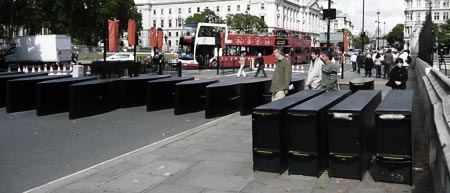
Rising bollards in Silver Street, Cambridge

Rising bollards near Darwin College, Cambridge. A man was killed here in May 2006 when his car hit the right-hand bollard; see third photo below.

Many thanks to Steve Portigal and Josh for suggesting this subject!

Bollards which automatically retract into the road surface to allow certain vehicles to pass, and then rise again, are becoming increasingly common on public roads in the UK; whereas previously, they might have been used at the entrance to a private car park as a more visually appealing alternative to an automatic barrier, many authorities are now using them to enforce traffic control in urban areas, with the category of permitted vehicles including buses, emergency services, postal vans, and so on. (I’m not sure about taxis; I think this varies with city*). The recent compilation of CCTV clips by the Manchester Evening News (link via BoingBoing) showing ‘non-permitted’ cars and vans hitting rising bollards in Manchester, as the drivers try to follow close behind permitted vehicles has got a lot of attention, with reactions ranging from “stupid drivers deserve what they get” to “how is causing thousands of pounds’ worth of damage to punish a minor crime ever justifiable?” (There’s also this video showing a higher-speed crash – not sure if this is in Manchester too).

Rising bollards in Manchester Rising bollards in Manchester
Stills from the CCTV compilation: the rear nearside wheel of the black 4×4 is off the ground. The van’s windscreen has been damaged by the driver’s head hitting it.

As an architecture of control, what can we say about the rising bollard? Is it merely a ‘restriction of access’ device, like a padlock? Or is it actually intended (to some extent at least) to damage the vehicles of non-permitted drivers, and injure them?

The official line would be the former, of course, but going by the dominance of the “stupid drivers deserve what they get” viewpoint in public comments on the Manchester video, I would suggest that a vindictive streak is pretty significant, and there’s no reason to think it might not also be among traffic planners.

The extensive (25 page) discussion at the road enthusiasts’ site SABRE also contains both points of view, and others. One logical argument which is well made, I think, is that if the drivers expected to damage their cars, they wouldn’t have tried to follow the buses. Therefore, the warning signs/road markings (knowledge in the world) or their prior experience of these systems (knowledge in the head) cannot have been sufficiently clear to discourage them from trying to sneak through. Yes, they knew that they “weren’t supposed to” drive through, and knew that buses were, so they tried to sneak in behind, but the drivers can’t have been fully aware of how quickly the bollards rose, or they wouldn’t have attempted it, would they? Most people don’t deliberately wreck their cars.

This is an important point. The system is not designed to be forgiving of mistakes. Now, we can say “well, why should it be? Those drivers shouldn’t try to break the law,” but in the real world, people do make mistakes. That’s why pencils have erasers. A car driver following a bus may have his or her vision of the warning signs obscured, and may be driving at a perfectly sensible speed, but still hit the risen bollards. A car driver following another car which externally looks like any other, but which is (for whatever reason) a permitted vehicle (with a transponder on board) may see the warning signs, and take them in, but, seeing the bollards lowered and the car in front driving at a constant speed, may assume that the bollards are disabled or permanently down, and so continue at exactly the same speed, and not be able to brake in time to avoid hitting the risen bollards. Bollards in some cities are only operational at certain times of day, and in certain directions; unless the warning signs themselves have a very clear variable display (Cambridge’s are fairly good), can we really expect drivers to read the times from the sign as they go past following another vehicle?

There are two much more sensible systems suggested in the SABRE discussion:

‘PeterA5145′

If this system is needed, then surely there should be conventional red lights with the bollards only rising a few seconds after the lights have changed to red (as with a level crossing). If you’ve never come across such a thing before it is not remotely obvious.

‘True Yorkie’

Perhaps a better idea would be to have a ‘vestibule’ system, with 2 bollards, spaced exactly a bus length apart. As the bus passed over the first lowered bollard, it’d stop immediately for the next bollard. As it waits for the second bollard to lower, the first would raise. Any car that tried to get in with the bus would have to shunt the bus to fit into the vestibule.

Either of these would be much better than the existing system. Both ‘design out’ the likelihood of mistakes – the vestibule system especially so.

Rising bollards in Silver Street, Cambridge: the driver of the Shogun was killed; image from Véro
The fatal accident at the Silver Street bollards in Cambridge (photo from Véro’s blog); this photo of the same bollards as my photo at the top of this post.

To a large extent this issue seems to come down to a debate on the old “if you’re not doing anything wrong, you’ve got nothing to fear” argument. Again, it’s a subject for a future post** but I find the repeated use of this, by politicians especially, to justify every erosion of established freedoms, both sly and egregious: there’s a reason why I can’t legally shoot you if you walk up my garden path, or electrify my car body shell (OK, it’s fibreglass, in fact, but the same principle applies). Perhaps the “if you’re not doing anything wrong, you’ve got nothing to fear” brigade would let happily let the authorities read all their personal correspondence, and indeed would be happy to have all private property covered in mantraps and landmines to enforce “trespass prevention”? After all, “if you’re not doing anything wrong, you’ve got nothing to fear.”

Jeremy Wagstaff applies this kind of thinking to the bollard issue to demonstrate its absurdity, and its distasteful corollary:

My tuppenny’s worth: I think traffic maiming (as opposed to traffic calming) is a great idea but doesn’t go far enough. We need similar measures to punish, sorry deter, drivers who routinely flout the law and common decency. Why not, for example, deploy the retractable bollards elsewhere, like

* the centre of a restricted parking space, so it would rise at the end of the designated period, impaling the vehicle if the driver had overstayed his alloted time;
* at random points on the hard shoulder on toll roads/motorways so that cars illegally using it as a fast lane would be impaled, or flipped over into an adjacent field

Where necessary, bollards could be replaced by other features such as

* a mechanical arm, installed on the roadside and connected to a speed sensor, which would crush cars passing by too fast or too slow, depending on what irritated other drivers the most.
* or cars driving through built-up areas too fast would be taken out by snipers deployed in trees/tall buildings. If necessary the snipers could be automated.
* cars straddling two lanes or changing lanes without indicating first would be sliced in half by retractable blades intermittently rising out of the demarcating lines
* motorbikes using the sidewalk (a particular bane in my neck of the woods) would risk having their tyres slashed by strips of spikes activated by the annoying sound of approaching underpowered Chinese-made engines.

Norms, restriction and punishment

It’s worth thinking about the norms of restrictions and warnings we encounter in everyday life.

Many – in fact most – signs indicating the prohibition of particular behaviour do not suggest immediate punishment to us. The sign may say “Do not drop litter” but most people who do drop litter know that unless someone is watching, and decides to do something about it, they will get away with it. A road sign may say ‘No Parking”, but if no-one’s around, is it wrong to stop? Is it a crime if no-one finds out, and it doesn’t affect anyone?

We can laugh about falling trees in the forest and Schrödinger’s cat, but I think that for most of us, there is a very clear mental distinction between “incorrect” behaviour which we know will be “punished” immediately by the realities of the system (e.g. pointing a gun at our face and pulling the trigger, or driving through a level crossing barrier when a train is coming), and “incorrect” behaviour which we know is technically wrong, but which only the fear of being caught (and punished) stops us doing. Most drivers speed, but they wouldn’t speed if they knew there was a police car behind them.

So, our mental model of a ‘No Entry’ sign is that it signifies an arbitrary restriction, but one which carries no immediate punishment, unless, say, it’s a single-track road and something’s coming towards us at speed. If we ignore the sign, we might find we’re going the wrong way down a one-way street, or we might get caught (by camera or by police on the ground), but that’s a risk that people may take if they perceive it to be very low. If we can see that it’s not a one-way street, and we can see other vehicles passing that way, then there is apparently a fairly low risk to ignoring it. Our expectation is that we will get away with it.

When bollards then rise out of the road immediately in front of us, our mental model is proved wrong. The norm is shattered. This is a system that immediately punishes those who infringe the No Entry sign. This is a familiar, apparently docile ‘Keep off the grass’ sign accompanied by snipers watching very carefully.

Now, the UK’s Department for Transport clearly recognises something along these lines: the norms of the bollard systems are different to those drivers may have come to expect, and an additional aspect is also identified: that of the “control of all vehicles/control of individual vehicles” distinction:

Established practices of traffic control using traffic signals do not control separate vehicles; streams of vehicles are controlled with drivers able to see the signals from a significant distance. Rising bollards are normally used to control individual vehicles in that they are raised each time a vehicle has passed over them. The requirement, therefore, is for short range signalling… Unless drivers have a clear view of the bollards, an indication should be given to drivers that the bollards have fully retracted.

In conjunction with the vestibule system suggested in the SABRE quote above, that seems the most sensible approach to take. The DfT also has some other sensible guidelines:

Three wheeled vehicles, motorcycles and vehicles with trailers, for example, may not be sensed by the vehicle detectors used with automatic bollard systems. It will almost certainly be necessary to provide alternative means of access for some classes of road users or vehicles. The possibility of a device rising under a wheelchair or pushchair should be taken into account. The risks could be mitigated to some extent by providing suitable alternative access adjacent to the bollards, and by using a coarse road surface to divert pedestrians away from the bollard installation [interesting! - see also the pebble paving to make barefoot walking uncomfortable, mentioned here]. Whilst most applications will be to enable the passage of one vehicle at a time, there will be instances where two or more vehicles attempt to pass through in close succession. The system should ensure that bollards cannot rise beneath a vehicle because of the danger this would create. It is better to risk a certain amount of violation by “tailgating” vehicles, rather that put road users at risk. Any system, however well designed, will fail to operate correctly on occasions. The system should fail to a safe state, ideally with the bollards retracted. In the event if an accident the emergency services may need to override the control system and retract the bollards.

Still, for all the effort (and costs) involved in installing and running the bollard systems, would it really not be better to look at the subject from a greater distance? The roads drivers want to use are in many cases roads which used to be open to all traffic – indeed, in Cambridge, Silver Street used to be one of the main routes into the city centre, part of the old A603 from Bedford. The current alternative route from west to east is significantly longer and almost always very congested. It passed close outside my window when I was a student; I know. It’s understandable in many cases why drivers want to use the old route.

The real issue that needs to be addressed is why people want to drive into these areas. There is always a reason; people are rarely “stupid” with no explanation.

*I’d like to get into the “are taxis public transport?” debate another time: not now though.
**There was a quite astonishing article I read about a year ago where a police chief in a small US town had (seriously?) suggested putting CCTV inside every home in the community, for constant monitoring, and used the same “if you’re not doing anything wrong, you’ve got nothing to fear” argument; if I can find this again, I’ll post the link.

Read More

A couple of months ago I posted about the ‘shaping behaviour’ research of RED, part of the UK Design Council. At the time I noted in passing a classification of design approaches for shaping behaviour, mentioned by RED’s Chris Vanstone: “stick*, carrot or speedometer.” It’s worth looking further at this classification and how it relates to the spectrum of control, especially in a technology context:

Yes, it's a stick (well, a branch), next to a PCB

Stick

If we define ‘stick’ as ‘punishing the user for attempted deviation from prescribed behaviour’, then many of the architectures of control we’ve examined on this site demonstrate the stick approach. They’re not explicitly ‘technologies of punishment’ in Foucault‘s phrase, but rather a form of structural punishment. The thinking seems to be (for example):

  • If you try to sleep on this bench, you will be uncomfortable (and hence won’t do it again)
  • If you try to copy a DVD, your copy will be degraded and your time and blank DVD wasted (and hence you won’t do it again, or will buy another authorised original)
  • If you try to view our website using a competitor’s browser, your experience will be broken (and hence you’ll switch to our browser)
  • If you try to skateboard here, your board will be damaged and you will be maimed (and hence you won’t do it again)
  • …and so on. There are numerous other examples from software and urban planning, especially.

    The thing is, though, for each of those ‘sticks’, a large percentage of people will not be obedient in the face of the ‘punishment’. They’ll try to find a way round it: a way of achieving their original objective but avoiding the punishment. They’ll search for what others in similar situations have done (e.g. DeCSS in the DVD example) or ask among friends until they find someone with the required expertise or who knows about an alternative. They may even actively destroy the ‘stick’ that punishes them. In some cases they might not even understand that they’re being punished, simply seeing ‘the system’ as beyond their comprehension or stacked against them.

    Equally, there isn’t always a rational strategy behind the ‘stick’ in the first place. The anti-homeless bench doesn’t ‘solve’ the ‘problem of homelessness’. It just punishes those who try to lie down on it without offering an alternative. It’s punishment with no attempt at resolving the problem.

    If a stick does get people to change their behaviour in the intended way, it will be accompanied by resentment, anger and dissatisfaction. It may only be fear of the consequences which prevent actual rebellion. In short: using sticks to change people’s behaviour is not a good idea.

    Carrots: image from image.frame
    Image from image.frame

    Carrot

    A ‘carrot’ means offering users an incentive to change their behaviour. This moves away from actual control to something closer to some aspects of captology – making a persuasive case for behaviour change through demonstrating its benefits rather than punishing those who disobey.

    To some extent, control and incentives may be incompatible. Taking away functionality from users then showing them how they can get it back (usually by paying something) might be a classic combined “carrot and stick” technique, but it’s also bordering on a protection racket, and it doesn’t fool many people.

    However, can control be used in conjunction with genuine incentives to serve the agendas of both sides? Electric lights that turn off automatically if no-one’s in the room take some control away from the user, but also offer benefits to both the user (lower electricity bills) and society as a whole (less energy used). But if they turn off automatically, is there actually any incentive for the user to change his or her behaviour? If we’re always spoon-fed, will we ever learn?

    Perhaps mistake-proofing measures or forcing functions which allow a user to increase his or her productivity or safety, in return for giving up some ‘control’ – which may not be highly valued anyway – fit the definition best. If I’m working in a factory painting coachlines on hand-built bicycles, a steady guide arm that damps my arm vibrations – but only if I also take care as well – takes some control away from me, but also prevents me making mistakes, allowing me to paint more coachlines per hour, more accurately. It also helps my employer.

    But that’s a very weak degree of control. Unless anyone can come up with any counter-examples, I would suggest that providing real incentives for users to change their behaviour is fundamentally a very different approach to the ‘control mindset’ (unless you are trying to trick people by offering false incentives, or by understating what they could lose by changing their behaviour).

    I’ll get round to speedometers in a future post, since this approach is worthy of a deeper treatment.

    *The phrase “carrot and stick” seems now universally to imply “offering incentives with one hand and punishment with the other” (though not necessarily at the same time), rather than the “carrot dangling from a stick, just out of reach” meaning (i.e. “motivating people to perform with incentives which will never be fulfilled”) which I first assumed it to have when I heard the phrase as a kid (I’m not the only one with this issue). In this post, I’ll use “stick” to mean “punishment”.

    Read More

    News Sniffer
    Image from News Sniffer

    News Sniffer‘s Revisionista monitors alterations to published news stories from a variety of sources by comparing RSS feeds, sometimes revealing subsequently redacted information or changes of opinion (e.g. note the removed phrase in the first paragraph of this story about Cuba). While many of the changes are simply re-wordings for clarity or to correct grammatical errors, there are certainly also some instances of more substantial revisions – see the ‘recommended’ list.

    Perhaps more revealing is News Sniffer’s Watch Your Mouth, which shows the reactively moderated comments removed from the BBC’s ‘Have Your Say’ threads. I’ve been reading this for a while – in fact I think I might have been one of the first subscribers via Bloglines – and am still amazed by just how many comments are removed by the BBC’s moderators, often making points which, though maybe controversial, are very much the voice of the common man and woman. Some are offensive, yes; others are genuine expressions of frustration or even first-hand annotations to or clarifications of aspects of the story above. Many are critical of the BBC, including those criticising the moderators for censorship of the very comments under dicsussion.

    Read More

    UPDATE: The code being used is from the Explorer Destroyer project, which has an explanation of its rationale here. It’s worth noting that it’s not just ‘Get Firefox’, but ‘Get Firefox with the Google Toolbar’, hence the $1 referral fee… I’d much rather have Firefox with some degree of privacy, to be honest. Thanks for the info, Joshua.

    This is what Töshöklabs’ website looks like in Firefox:

    Toshoklabs.com on Firefox

    And this is what it looks like in Internet Explorer (with a close-up of the text):

    Toshoklabs.com on IE
    Toshoklabs.com on IE

    I came across this site via an interesting piece at 3.7 crea.tv:

    “While I understand the frustration many designers have when dealing with making a site IE compatible, and I absolutely love the idea of more users browsing with Firefox, we have an obligation to make sure the IE version of a site looks just as good as its Gecko counterpart. It is, after all, the most common browser in use hands down… It wasn’t until I saw this “IE incompatible site” that I realized how bad this trend has spread… The designers outright do not let you browse their site if you are on IE. They shut out 80% of the Internet without batting an eye. This is no different than the painful old trend of stating how the web page should be viewed, IE: “Best viewed in 800×600 on IE 3.2″.”

    The thing is, the Töshöklabs site is not actually ‘IE incompatible’ at all. The site is deliberately made unusable in IE by showing a hidden layer, invisible to Firefox (and Opera) users:

    Toshoklabs.com source

    This is a clever trick; I’m not quite sure what my reaction should be. Are the site’s creators saying “IE users aren’t the sort of people we want using our site”, or just “Get educated“? It’s surely the latter, but they perhaps forget that many possible visitors are stuck in offices where they’re just not permitted to install Firefox (or other alternatives), or are using other types of specialised browsers*, screen-readers, etc. Not everyone is able to make a choice about the software he or she uses.

    I understand exactly what Töshöklabs are trying to do, and the aim of spreading the message of alternative software is a laudable one (as is their giving away DRM-free music), but the implementation is only one step away from MSN’s deliberate anti-Opera behaviour. It would be better from a usability point of view to have that “We see you’re using Internet Explorer…” message as part of the homepage, large enough to catch visitors’ attention but not take control away from them.

    *e.g. here’s what it looks like in Lynx – not a very intelligent script, then!
    Toshoklabs.com on Lynx
    Toshoklabs.com on Lynx

    Read More

    Blue lighting makes it more difficult to see veins
    Blue lighting makes it more difficult to see veins

    Blue lighting is sometimes used in public toilets (restrooms) to make it more difficult for drug users to inject themselves (veins are harder to see). The above implementation is in Edinburgh, next to the Tron Kirk.

    It was more difficult to see my veins through my skin, but there was normal-coloured lighting in the street outside, and one would assume that the users would thus just go outside instead, though the risk of detection is greater. (An additional result of the blue lighting is that, on going outside after spending more than a few seconds in the toilets, the daytime world appears much brighter and more optimistic, even on an overcast day: could retail designers or others make use of this effect? Do they already?)

    So the blue lighting ‘works’, but is it really a good idea to increase the risk that an injection will be done wrongly – maybe multiple times? This is perhaps a similar argument to that surrounding delibrately reducing visibility at junctions: the architecture of control makes it more dangerous for the few users (and those their actions affect) who ignore or bypass the control. This seems to be an architecture of control with the potential to endanger life, although the actual stated intention behind it probably includes ‘saving lives’.

    Without knowing more about addiction, however, I can’t say whether making it difficult for people to inject will really help stop them doing it; it would seem more likely that (as in the linked Argus story), the aim of the blue lighting is to move the ‘problem’ somewhere else rather than actually ‘solve’ it – as with the anti-homeless benches, in fact.

    Another example in this kind of area is the use of smoke alarms specifically to prevent people smoking in toilets, e.g. on aeroplanes (the noise, and embarrassment, is a sufficient deterrent). There’s even been the suggestion of using the Mosquito high-pitched alarm coupled to a smoke detector to ‘prevent’ children smoking in school toilets (I’d expect that quite a few would deliberately try to set them off; I know I would have as a kid). A friend mentioned the practice of siting smoking shelters a long way from office buildings so that smokers are discouraged from going so often; this backfired for the company concerned, as smokers just took increasingly long breaks to make it ‘worth their while’ to walk the extra distance.

    Read More

    @danlockton

    Upcoming talks & events

    I'm speaking or running workshops at:

    Some of my previous presentations

    Comments & trackbacks

    Blog 2005-date