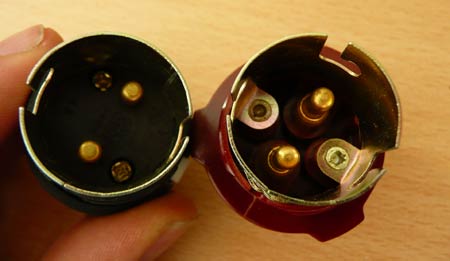
Standard 2-pin bayonet cap (left) and 3-pin bayonet cap BC3 (right) fittings compared
Summary for mystified international readers: In the UK new houses/flats must, by law, have a number of light fittings which will ‘not accept incandescent filament bulbs’ (a ‘green’ idea). This has led to the development of a proprietary, arbitrary format of compact fluorescent bulb, the BC3, which costs a lot more than standard compact fluorescents, is difficult to obtain, and about which the public generally doesn’t know much (yet). If you’re so minded, it’s not hard to modify the fitting and save money.
A lot of visitors have found this blog recently via searching for information on the MEM BC3 3-pin bayonet compact fluorescent bulbs, where to get them, and why they’re so expensive. The main posts here discussing them, with background to what it’s all about, are A bright idea? and some more thoughts - and it’s readers’ comments which are the really interesting part of both posts.
There are so many stories of frustration there, of people trying to ‘do their bit’ for the environment, trying to fit better CFLs in their homes, and finding that instead of instead of the subsidised or even free standard 2-pin bayonet CFLs available all over the place in a variety of improved designs, styles and quality, they’re locked in to having to pay 10 or 15 times as much for a BC3 bulb, and order online, simply because the manufacturer has a monopoly, and does not seem to supply the bulbs to normal DIY or hardware stores.
Frankly, the system is appalling, an example of exactly how not to design for sustainable behaviour. It’s a great ‘format lock-in’ case study for my research, but a pretty pathetic attempt to ‘design out’ the ‘risk’ of the public retro-fitting incandescent bulbs in new homes. This is the heavy-handed side of the legislation-ecodesign nexus, and it’s clearly not the way forward. Trust the UK to have pushed ahead with it without any thought of user experience.
One of the most egregious aspects for me is the way that Eaton’s MEMLITE BC3 promotional material presents users with, effectively, a false dichotomy between the ‘energy saving BC3′ and the energy-hungry GLS incandescent filament tungsten bulbs, as if these are the only two options available. There is no mention at all of standard 2-pin bayonet CFLs which have all the advantages of the BC3 with none of the disadvantages. The adoption of CFLs has been, I would argue, in large part because they are widely available as drop-in replacements for standard 2-pin bayonet (or Edison screw) bulbs. If they’d all required special fittings, very few people would have bought them.
Anyway, if you don’t fancy swapping your BC3 fittings for standard 2-pin bayonet ones (which is cheap but would(?) presumably make your home non-compliant with part L of the building regulations - any knowledgeable readers able to clarify this?), it isn’t actually too difficult to get a 2-pin bulb to fit acceptably. You will need a pair of pliers, ideally thinner/longer-nosed than the ones in my photos. I should warn you to TURN OFF THE ELECTRICITY FIRST. Unless you’re absolutely sure that someone else won’t walk in and flip the light switch, don’t rely on just turning this off. Turn it all off at the main switch for the house.
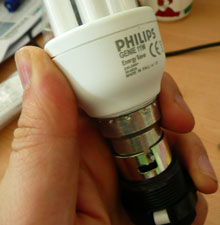
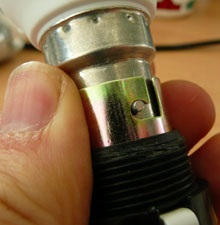
Here (above) is a Philips Genie 11W 2-pin bayonet CFL. It fits properly into a 2-pin bayonet fitting. When you try to fit it into the BC3 fitting (below), one of the pins will go into one of the J-slots OK, but due to the offset of the other slots, the other pin won’t go in. Ignore the third slot.
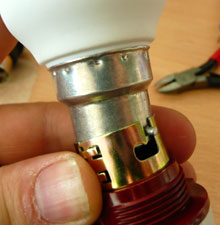
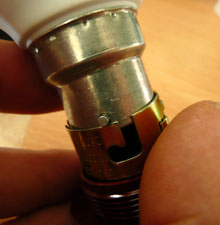
But if you look carefully at how the non-fitting pin lines up with the slot (below), you can see that the bottom end of the slot, i.e. where the pin would sit if it could be got into the top of the J, is (just) to the left of the pin. (See the line I scratched on the fitting.) That is, if you could get it there, it would still sit in place without immediately falling out.
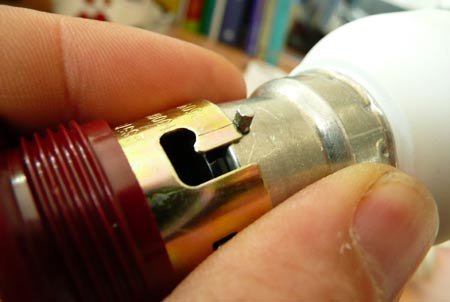
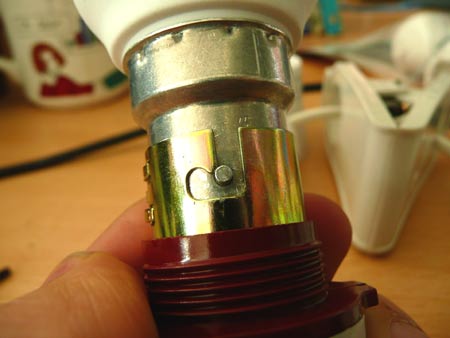
So, with the pliers (making sure the electricity really is off), bend the edge of the non-fitting slot (the inside edge of the J) inwards and fold it back on itself, squeezing it as tight as you can (below two photos):
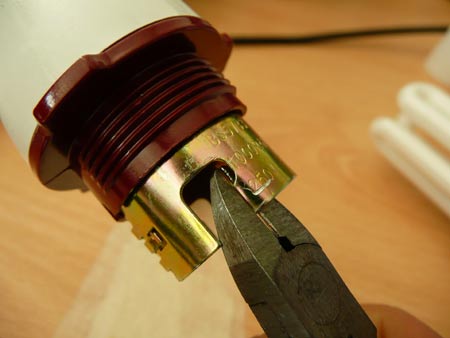
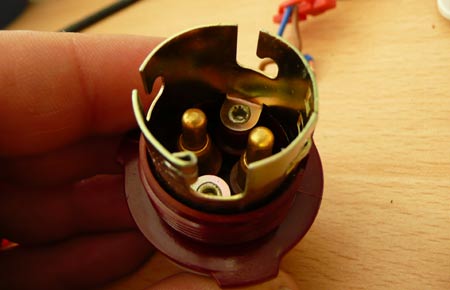
Now try the 2-pin bayonet bulb again (below) - it should fit OK, with a bit of wobbling perhaps. One pin should fit under the bit you just bent; the other should butt up against the inside corner of the J on the other side. It’s not perfect, but the friction there is enough to hold the bulb in place OK.
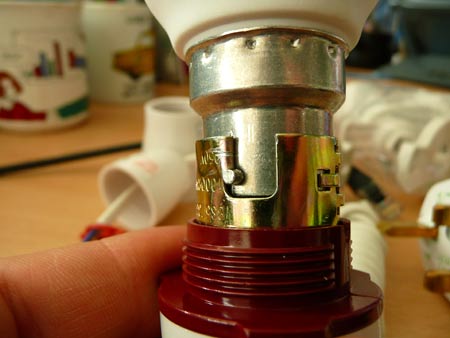
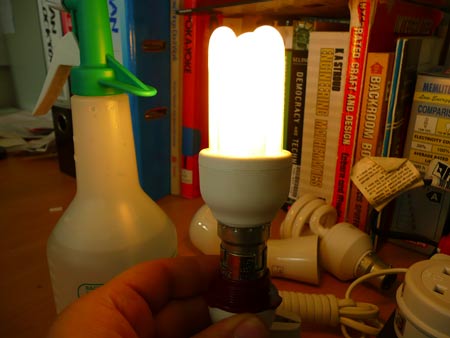
Switch on the electricity again, and there you have it: any standard 2-pin bayonet bulb, working, in a BC3 fitting (below). Given the amount of free CFLs handed out by various organisations, you could probably replace all the BC3 bulbs in your house for zero cost, once they come to the end of their lives.
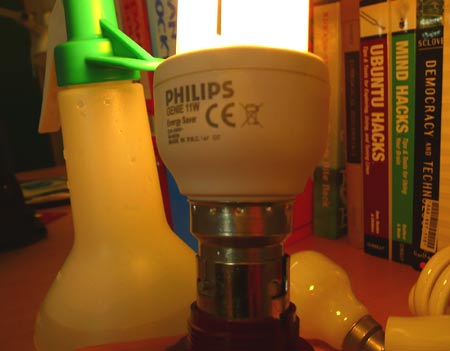
Disclaimer: I can’t accept any responsibility for injuries, non-compliance with building regs, incidental damage, etc. The above is just a proof of concept, etc. Have fun.


It seems to me this is a perfect opportunity for someone to sell 2-pin to 3-pin adapter sockets. The bulbs would sit up a little higher but you’d probably end up with a more secure mount.
It’s a good point. An adaptor’s available that’s effectively the base of a BC3 bulb with the starter/ballast included, so you attach the tubes themselves (which are cheap) to the base, but this isn’t the standard.
Someone from an Australian company that makes T8-T5 fluorescent tube adapters left a message on a previous post suggesting that if someone could give them more details and send some fittings/bulbs over, they would look at producing a BC3-’BC2′ (actually just ‘BC’ / ‘Ba22d’) adaptor. I should probably get on to that.
P.S. I should also thank George Preston who alerted me to the existence of the BC3 system in the first place.
These are weird.
I’ve gone my whole life without ever seeing any of these alternative “BC2″ and “BC3″ bulbs or sockets — only screw-base bulbs and the corresponding sockets. These posts almost seem to be coming from another planet or something.
(Most fittings here now have CFLs. One or two that don’t are also rarely or never used. One of the main fittings is unfortunate, though — it has a dimmer, and the CFLs’ labeling warns against using them with a dimmer. Is this an issue if the dimmer is only ever left in either the completely-off or the completely-on position rather than actually used as a dimmer? I can’t replace the dimmer itself — lack of tools, parts, and expertise, plus the landlord might be annoyed.)
If you only use the dimmer in the ‘off’ position or the fully ‘on’, I don’t think it will damage the CFL, because it’s either receiving standard mains voltage AC, or none at all. But make sure that when it’s off it really is off (i.e. no hum at all coming from the unit). And to go from off to on - do it quickly. If you run a standard CFL from a standard triac chopper-type dimmer, it tends to flicker on and off at lower dimmer settings rather than change intensity like an incandescent filament bulb would. This is bound to shorten the life of the bulb.
There are a lot of different bulb base standards around. One listed there which I hadn’t previously realised existed is the B22d-3 - 22mm Bayonet Cap 3 Pin (Railway) which I presume is an alternative to the BC3, perhaps used on railways so that it was not worth passengers’ while stealing the bulbs, since they couldn’t use them at home. Bit like the story of a shoe manufacturer which shipped containers full of right shoes separately from the left shoes, to reduce the likelihood of shoes ‘going missing’ en route.
P.S. It seems as if Lyvia lighting now produces BC3 bulbs too, so there is a (slightly) lower-cost competitor for Eaton’s MEM. Still, good luck finding it in your local hardware store.
It’s odd for competing suppliers to take even THIS long to materialize, given that there’s no “secret formula” involved. Anyone with a bit of skill at mechanical engineering can probably devise a bulb base that will fit those BC3 sockets with no other product-specific knowledge beyond what can be obtained simply by examining one of the sockets.
We’re not talking something difficult to reverse-engineer here!
that idea to bend back part of the light fitting is great, just done it and it worked perfectly. now i only have to spend £2 on a bulb and not £10 which has to be ordered. Thanks
reserch of cfl bulb instead of normalbulb
Wasantha: ?
Thanks for the advice. My Daughter has broken a bulb in her new flat and asked me to replace it. I have been to every local and High Street DIY place looking for a bulb to no availe. It’s crazy that this was ever allowed. I have bought a standard light fitting which I could easily swap out. I will try this fix first. I hope someone does bring out a retrofit solution and stop people being ripped off for these silly bulbs.
Thank you so much! I was not impressed when I broke my bedroom bulb in my new flat (little to ‘flipant’ with the duvet cover!) I bought a new bulb but it didn’t fit! My 1st thought was the house builders brother owns the 3 pin bulb company!!! Now I see its to do with conservation… not quite as irrate although … slightly daft as the courier has to deliver 1 bulb to me.. which no doubt causes 50 times the carbon footprint than my trip to Tesco which I was making anyway!!
Anyway - thanks for the tip… I will get my pliers out tonight (and hopefully stop stubbing my toes on my chest of drawers!)
Regarding the extent of low energy lighting needed in a new dwelling to meet the requirements of Building Control, Approved Document L1A, Para. 43 states:
Reasonable provision would be to provide in the areas affected by the building work, fixed energy efficient light fittings that number not less than the greater of:
a).
One per 25m2 of dwelling floor area (excluding garages) or part thereof; or
b).
One per four fixed lighting fittings.
A light fitting may contain more than one lamps.
The Approved Documents are freely downloadable from the Goverment’s website, do a Google search for ‘Approved Documents’. Or go to:
http://www.planningportal.gov.uk/england/professionals/en/1115314110382.html
It would not be so bad if the BC3 bulbs lasted for any length of time but they are not very good quality and do not last anything like their expected life.
Also the cost saving of these type of bulb is completely negated by the additional expense the cheapest I have found is £9.50 plus delivery. So I have changed the fitting for the standard BC fitting. Nothing in the regulations prevent this it is only the newbuild people who have misunderstood the regulations and believe that they must make it so that the bulbs can not be changed for standard ones. Perhaps the answer is to make filament BC3 bulbs.
Environmental impact once you have worked out the whole life costing in carbon footprint (I hate that term) you will find that the low energy bulbs unless left on for at least 6.75hrs each day actually use more energy.
So is it possible to simply swap the fitting for standard ones?
For about a fiver I could swap all of the stupid things in my new flat over, or I could spend 10 a bulb on these dim pieces of rubbish.
If I can just swap the fittings I’m off to Wilko’s now, its a total no-brainer.
Hi
Just a word of warning re: the Lyvia lighting cheaper alternative. The pins are equally spaced unlike the BC3 in the diagrams (it’s actually the B22D) and won’t fit your new build light fittings - so there is no cheaper alternative!
Best altering your fittings as above