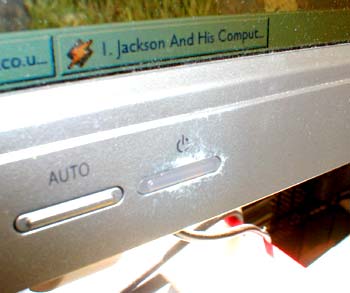
From the Sunday Times, ‘Standby buttons face axe to curb energy waste’:
“Ministers want to do away with the standby buttons that allow [users] to flick their TVs and other electronic gadgets on and off while moving barely a muscle…
Figures… show that gadgets left unnecessarily on standby or connected to chargers squander electricity worth £740m each year and are responsible for 4m tonnes of excess carbon dioxide emissions each year.
The biggest culprits are not televisions but stereo systems, responsible for £290m of wasted energy, followed by video recorders, £175m, televisions, £88m, games consoles, £70m, computer monitors, £41m, DVD players, £19m, and set-top boxes, £11m. Mobile phone chargers left plugged in unnecessarily waste £47m of electricity each year, enough to supply 66,000 homes.
The government has rejected one proposal, from the energy company Scottish Power, that standby buttons on existing electrical products be removed or disabled. But it will work with manufacturers to ‘design out’ standby buttons from new products… One likely recommendation for some products is that they be designed to switch themselves off.”
This seems a fairly sensible application of control within the design process, with the ‘feature deletion’ being done to fulfil socially beneficial intentions rather than purely commercial ones. The less energy devices use, the less money the customer spends on electricity, as well as reducing the environmental impact.
Nevertheless, there are millions of people for whom a standby button is a very useful – or even essential – design feature. If you’re confined to bed, or a static chair for most of your day, whether through disability, long-term illness or simply age, that remote control button (on the TV, radio or even the room lighting) is a godsend. One would hope that from an inclusive design point of view, there will still be such devices available, and – if I’m honest – I think they should still be available to everybody, if desired. There should be no need to ‘prove’ disability in order to buy a TV with a remote control standby function.
An alternative is, of course, a remote control/standby system that doesn’t use anywhere near so much power when the device is on standby. A clever range of current-limiting gang sockets are already available which detect the amount of current a device actually needs to draw when on standby, and limits that which it can draw to precisely that. Alternatively, we might design products so the ‘standby’ signal from the remote control is intercepted by an entirely separate, DC circuit, maybe battery-powered and drawing a minuscule current, which then switches the mains on and off using a relay when required.
The government proposals are – on the face of it – largely a rare case of a ‘win-win’ architecture of control (see diagram), though of course we need to consider the effects of the manufacture and distribution of so many millions more products (and probably, the disposal of the old ones). If we argue that this would have happened anyway (which is surely true) then the effect will be better than if the replacement devices had no environmental considerations going into their design, but this is the kind of situation where a full life-cycle analysis would be very useful.
See also Case study: Optimum lifetime products.
Pingback: Architectures of Control in Design » Some interesting aspects of built-in obsolescence
Pingback: Shaping behaviour: Part 2 at fulminate // Architectures of Control
Pingback: Making energy use visible at fulminate // Architectures of Control